
ADELAT held the Webinar “Electricity and Telecommunications in LATAM: sharing of infrastructure and services”
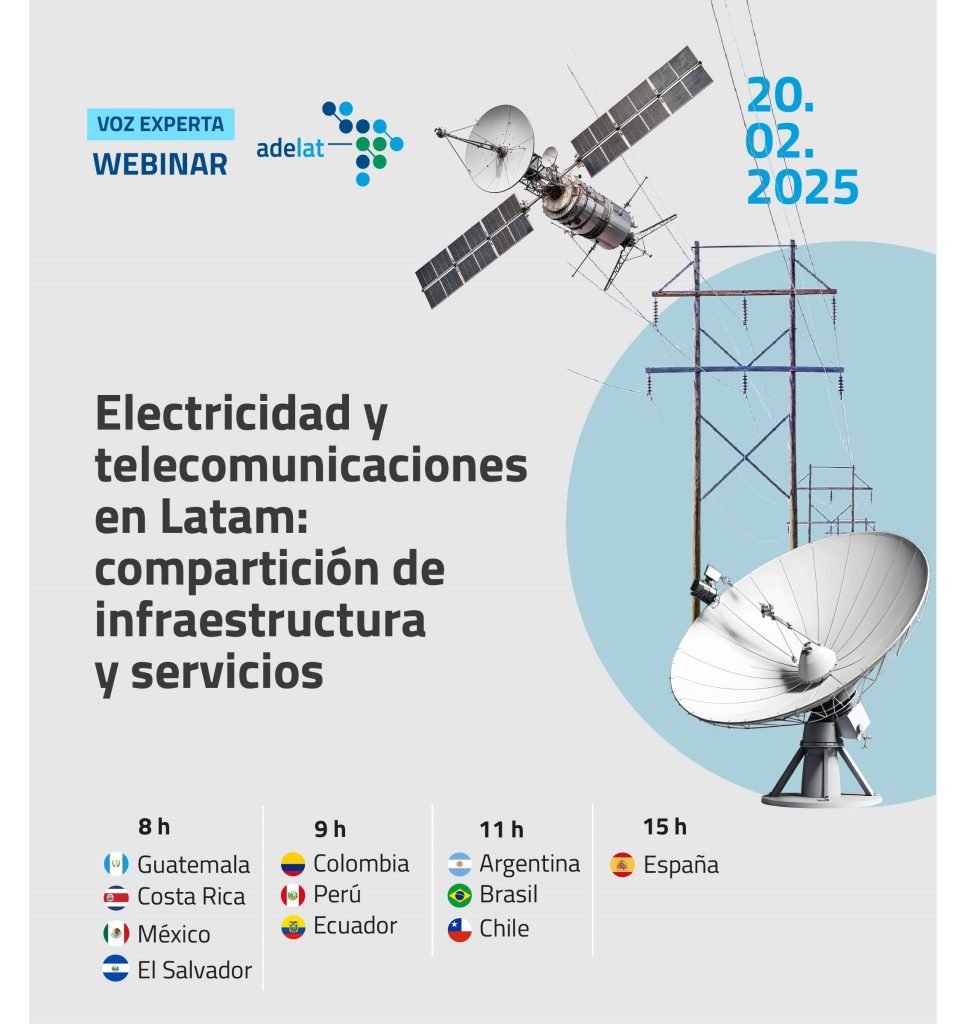
The Association of Latin American Electricity Distributors led the first meeting of the year of the ADELAT Expert Voice cycle, which was the analysis of the benefits and challenges of sharing the infrastructure between the electricity and telecommunications companies of the region.
The opening was in charge of the Executive Director of the Association, Alessandra Amaral. Afterwards, the Director of Knowledge Management, Roberto Cajamarca, presented the main conclusions of the last DSO Brief “New synergies between electricity and telecommunications”.
Cajamarca highlighted the role of energy as an enabler of connectivity and the importance of telecommunications companies to make the digitalization of electrical networks possible. In this regard, he detailed that “5G technology and optical fiber are fundamental for the modernization of electrical distribution systems, as they allow the deployment of smart grids, intelligent measurement and demand management”.
He also addressed the main challenges to enable infrastructure sharing, such as regulatory fragmentation, insufficient remuneration for shared use and the proliferation of telecommunications operators, among others. Subsequently, he reviewed the current situation of five countries in the region and cited successful cases implemented in Italy, Ireland and Japan.
Then, Amaral introduced the invited experts. The first speaker was Carlos Alberto Calixto Mattar, Director of the Electricity Working Group of ARIAE and Regulation Superintendent of Distribution Services of ANEEL. Throughout his exposition, Mattar went deeper into the Brazilian regulatory context. In this regard, he assured: “We have a regularization plan that foresees a series of rules, which was presented to public consultation in 2021 and which is still not properly closed with the telecommunications companies”.
On the other hand, he pointed out that the main challenges are the disorganized and clandestine occupation, the low priority of activities related to shared use by distributors, the increase in costs and the imbalance in the relationship between distributors and telecommunications companies.
Next, Alejandra Arenas Pinto shared her experience as Regulatory Design Coordinator of the Communications Regulatory Commission (CRC) of Colombia. She highlighted as a milestone the sanction of a law in 2019 that gave competence to the CRC in matters of regulation on shared use of infrastructure. She detailed that subsequent resolutions lowered tariffs for the common use of posts, ducts and towers with the aim of encouraging the increase in cabling groups and facilitating coverage amplification.
“We used the opportunity cost concept to establish what the value should be so that the telecommunications operator finds it economically reasonable to share the infrastructure”, she detailed. However, among the rights that persist, she ensured that “the electric energy sector continues feeling that regulation favors telecommunications” and that it is necessary to analyze mechanisms so that shared use becomes reciprocal and that, in this way, the electric sector can also access the telecommunications infrastructure.
Thereafter, Alberto Villa, Head of Grids Advanced Services at ENEL, explained his vision about the benefits of sharing resources. “Using the existing infrastructure allows us to obtain a significant saving in construction costs and commissioning time, and provides a benefit not only in economic terms but also from an environmental and sustainability point of view”, he assured.
He commented that, in Europe, large antenna towers are installed in electrical substations and 5G antennas on posts and other elements of the electrical grid. Furthermore, he assured that in Italy they are looking for sustainable and synergistic developments to use electric vehicle charging stations. “The objective is to guarantee efficient, effective, equitable and sustainable development”, he concluded.
Finally, Atila Branco, CTIO of Fibrasil, ensured that neutral fiber is the simplest and easiest way adopted by many brazilian wideband distributors. He stated that this alternative has a large market but must be consolidated; and that it is necessary to regularize the situation and establish healthy prices that represent mutual benefit.
To conclude, an exchange space was opened where assistants had the opportunity to ask questions to experts.
We thank all the attendees for being part of this meeting, which we trust will be the first of many ones that we will share throughout 2025 with the objective of continuing to build knowledge that allows us to go forward into an effective and sustainable energy transition.
*For more information or press releases, write to comunicacion@darkturquoise-zebra-776384.hostingersite.com