
Reclaiming Power: Innovation and Strategies for Non-Technical Loss Management in Latin America and the Caribbean
Editors: Joaquín Lazo (ADELAT), Dasla Pando (Universidad de Chile), Roberto Cajamarca (ADELAT), Francisco Inostrosa (Universidad de Chile), Javiera Jaime (Universidad de Chile), Alessandra Amaral (ADELAT), Rodrigo Palma (Universidad de Chile), Rigoberto Ariel Yepez-García (BID), Katherine Segura (OLACDE), Fitzgerald Cantero (OLACDE).
Year: 2026
This study provides a structured overview of non-technical loss management in the region. Based on a compilation of practical experiences from distribution companies, the document proposes a taxonomy of measures and practices that organizes a field that is often approached in a fragmented manner. This systematization facilitates the comparison of strategies, identifies intervention patterns, and contributes to the formulation of more coherent policies and action plans. As part of this effort, fact sheets for each measure have been developed, designed for easy reading and wide dissemination. These fact sheets synthesize operational lessons learned and allow for more direct appropriation by various stakeholders in the sector. These fact sheets, along with the repository of experiences that supports them, aim to become a dynamic tool, capable of continuous updating, incorporating new developments, and supporting the evolution of loss management strategies in the region.

No investment, no transition: the future of power distribution in Latin America
Authors and collaborators: Grupo Mercados Energéticos (GME), David Felipe Acosta, Viviana Vitto, Aldo Pessanha, Alessandra Genu Dutra Amaral, María Antonieta Borrero, Roberto Cajamarca Gómez, Alejandro Falkner Falgueras, Sandra Marcela Quijano López, Horacio Nadra, Luiz Felipe Falcone De Souza, Claudio Bulacio, Ernesto San Miguel, Hilario Vistolet, María José Perez Vanmorlegan, Patricio Molina, Gastón Blanquet, Clarissa Machado, Talita Darwiche, Mariana Silva Barreto, Francisco Mualim, Víctor Tavera, Pablo Jofré, Mónica Cataldo, Gina Pastrana, Sergio Zambrano, Dimas Carranza, Jorge Ponce, Julio Luján.
Year: 2024
This study’s main objective is to offer a detailed view of the investment needs in the power distribution segment of seven key countries in the region: Argentina, Brazil, Chile, Colombia, Ecuador, Guatemala, and Peru. This analysis focuses on the implementation of eleven key vectors associated with the energy transition, which include everything from electrification of new uses to the universalization of electricity service.

Regulatory challenges and improvements for electric distribution in the latin american energy transition
Authors and collaborators: David Felipe Acosta, Daniela Almeyda, Maria Claudia Alzate, Tiago Barros, Claudio Bulacio, Ramón Castañera, Carlos Centeno, Larissa Cunha, Talita Darwiche, Aniella Descalzi, Paula Fajardo, Lucas Guimarães, Pablo Jofré, Cristiano Logrado, Pedro Miquel, Rodrigo Moreno, Francisco Mualim, Alejandro Navarro, Marcela Quijano, Ignacio Santelices, Mariana Silva, Victor Tavera, Francisco Valencia.
Year: 2023
This document aims to establish the new role of the DSO as a key player in the regional energy transition, promoting the modernization of regulatory frameworks in order to migrate from the cost optimization vision to maximizing social benefits.

La medición en América Latina y el Caribe inteligente. Recomendaciones regulatorias para incentivar el despliegue de la medición inteligente a nivel nacional
Autor: Banco Interamericano de Desarrollo (BID).
Año: 2023
El objetivo de este informe es identificar el estado del arte en relación con el despliegue
de la medición inteligente (MI) en la región de América Latina y el Caribe (ALC), así como, realizar una serie de recomendaciones que puedan ser utilizadas por los reguladores energéticos de esta región, que permitan incentivar el despliegue de la MI de forma consistente con las necesidades específicas de cada país y las tendencias internacionales, especialmente en términos de digitalización y descarbonización.
La realización de este informe se ha centrado en el estudio de la última información disponible públicamente sobre la medición inteligente de los 26 países miembros prestatarios del BID que forman parte de la región de ALC.
Tariffs for Transition: Remuneration and tariff design for electricity distribution in Latin America
Editors: Alessandra Amaral, Roberto Cajamarca Gómez, Nívia Celestino, Joaquín Lazo Sánchez.
Contributors: José Alejandro Agudelo Guzmán, Gabriela
Alfaro Jiménez, Manuel Aranda M., Amelia
Carranza, David Chala, Vinicios Ferreira,
Josué Figueroa, Víctor Manuel Hincapié, Mitzi
Alejandra Lobatón Rodriguez, Jonatan Javier
Madiedo Ardila, Rodrigo Muñoz Baltar, Livia
Nicotra Da Silva, Jhonatan Plaza Martinez,
Paula Quiej, Pedro Martin Ramírez Sánchez,
Mauricio Alejandro Rivera Torres, Fabian
Mauricio Rivera Verde, Hans Rother Salazar,
Richard Ruiz M., Rodrigo Santander, Leslie
Sepúlveda, Leandro Tanaka, Luis Toledo
Campos, Ricardo Villalba, Felipe Zuloaga.
Year: 2026
This document analyzes remuneration regulation models and tariff designs applied across Latin America, identifying their main characteristics and gaps in light of the challenges posed by the energy transition. Based on a regional benchmarking exercise and a comparative analysis of international experiences, the study examines investment recognition, performance incentives, tariff signals, and revenue adjustment mechanisms. The objective is to provide a comparative perspective that contributes to the development of regulatory frameworks capable of supporting digitalization, electrification, and the integration of distributed energy resources.
Accelerating Smart Metering: Regulatory Drivers for Deployment in Latin America
Editors: Alessandra Amaral, Roberto Cajamarca Gómez, Joaquín Lazo Sánchez.
Contributors: Emilio Enrique Argüello Muñoz, Edward Arias, Cyro Boccuzzi, Claudio Bulacio, Dimas Carranza, Martín Cruz, José Manuel Da Peña, Valeria d’Ettorre, Alfredo Gallegos González, Yohana Galvis Silva, Martín Lamas Marcos Javier Leyes, Paolo Abeld Quispe Mamani, Ednelson de Moraes, Daniel Alejandro Moreno, Fernando Mosteirin, Daniel Picchi, Jorge Rodríguez Vargas, Juan Pablo Rodríguez Iglesias, Mauricio Rojas, Hans Rother Salazar, Santiago Scarlato, Franchesco Somontes Marin, Mena Testa, Juan Carlos Tripaldi, Eduardo Visintini.
Year: 2026
This paper analyzes the role of smart metering in the transformation of electricity distribution systems in Latin America, identifying the technical, regulatory, economic, and operational conditions necessary to move towards larger-scale deployments. The objective is to offer a comprehensive vision that allows understanding the current state of digitalization in the region, assessing its challenges and opportunities, and providing concrete elements for the design of public policies and business strategies that facilitate a sustainable adoption of Advanced Metering Infrastructure.
Distributed Generation: Towards a Sustainable Regulatory Model for Electricity Distribution
Editors: Alessandra Amaral, Roberto Cajamarca Gómez, Joaquín Lazo Sánchez.
Contributors: Daitshon Emerson Alata Ramos, Óscar Aldana, Dimitri Barros Pereira de Oliveira, Claudio Bulacio, Roman Buñay, Benjamín Dahrouge, Alfredo Gallegos, Jose Saul Guirola Argueta, Amanda Lacerda Prado, Jorge Mario Mijangos Rivas, Ednelson de Moraes, Mariano Nasarov, Edgar Armando Pérez Santos, Maria José Pérez Vanmorlegan, Aldo de Jesus Pessanha, Rodolfo Rennins, Hans Rother Salazar, Ernesto San Miguel, Donald Villegas Barrantes..
Year: 2025
This paper aims to analyze the expansion of DG in Latin America and the Caribbean, and its implications for the electricity distribution model. The main technical, economic and regulatory challenges associated with its integration are addressed, considering the effects on grids operation, service sustainability and infrastructure planning. It also highlights the opportunities that DG offers to modernize the grid, improve the flexibility of the system and strengthen the relationship with users, in a context where distribution companies are taking an increasingly active role in the management of the new energy ecosystem.
Retail Market Liberalization in Latin America
Authors and collaborators: Aldo Pessanha, Alessandra Genu Dutra Amaral, Roberto Cajamarca Gómez, Claudio Bulacio, Rodrigo Santander, Víctor Méndez Quesada, Karina Ruge, Yohana Galvis, Dimas Carranza, Talita Darwiche, Hans Rother Salazar, Gabriela Leoncini, Diego Sánchez Rodríguez, Ernesto San Miguel, Anelise Iwamoto, Julio Luján.
Year: 2025
This document aims to analyze the challenges and opportunities faced by distribution companies in the framework of the liberalization of the retail electricity market, evaluating the regulatory, operational, and competitive impacts. In addition, international best practices are examined to draw lessons applicable to the region. The factors that facilitate or hinder access to the free market by consumers will be analyzed, as well as the barriers that may arise in migration and the regulatory strategies implemented to ensure an orderly and equitable transition.
New synergies between electricity and telecommunications
Authors and collaborators: Aldo Pessanha, Alessandra Amaral, Roberto Cajamarca Gómez, Larissa Cunha, Sandra Marcela Quijano López, Claudio Bulacio, Patricio Molina, Hans Rother, Talita Darwiche, Ernesto San Miguel, Fabio Lira, Lucas Noura, Fabiana Susana Passos, Thais Moraes Abadio, Mariana Silva Barreto, Marco Sepulveda, Alejandro Valenzuela, Diego Fernando Echeverri Yepes, Monica Gomez, Romulo Inga, Julio Cesar Lujan Rojas, David Chala.
We thank Átila Branco, CTIO of Fibrasil, for his valuable contribution in reviewing this document.
Year: 2025
This paper aims to analyze the dimensions of this relationship, addressing the opportunities and challenges presented by the integration of both sectors. It explores how smart grids and shared infrastructure can accelerate the adoption of renewable energy, improve operational efficiency, and expand access to basic services in isolated communities. In addition, the critical role of collaboration between these sectors in ensuring the resilience and sustainability of the future energy networks is highlighted.
Digitalization and automation of power distribution: drivers and international good practices
Authors and collaborators: Aldo Pessanha, Alessandra Genu Dutra Amaral, Roberto Cajamarca Gómez, Sandra Marcela Quijano López, Claudio Bulacio, Andrés Camilo Agredo, Manuel Gómez, Pablo Vargas, Juliana Moreno, Dimas Carranza, Jorge Antonio Guillén Galván, Dimitri Barros Pereira de Oliveira, Talita Darwiche, Daniel Pichi, Pablo Molina, Alfredo Gallegos, Pablo Jofré, Hans Rother Salazar, Jorge Ponce, Julio Cesar Luján Rojas, Sócrates Vela Coral, Clarissa Machado Rocha, Marcos Soares, Ednelson de Moraes, Mariana Silva Barreto, Diego Sánchez, Ernesto San Miguel.
Year: 2024
The purpose of this document is to provide a general review of the opportunities and challenges that digitalization and automation present for power distribution systems in Latin America. It explores global trends in the implementation of advanced technologies, such as smart grids, Internet of Things (IoT), and artificial intelligence (AI), which are redefining traditional paradigms of electricity distribution. In addition, the current panorama in the region is discussed, highlighting the advances and limitations that characterize the different countries.
The resilience of power distribution systems
Authors and collaborators: Aldo Pessanha, Viviana Vitto, Alessandra Genu Dutra Amaral, Roberto Cajamarca Gómez, Sandra Marcela Quijano López, Mena Testa, Patricio Molina, Alfredo Gallegos, Claudio Bulacio, Ernesto San Miguel, Hilario Vistolet, María José Perez Vanmorlegan, Gabriela Leoncini, Clarissa Machado, Talita Darwiche, Mariana Silva Barreto, Dimitri Barros Pereira de Oliveira, Francisco Mualim, Pablo Jofreu, Gina Pastrana, Camilo Agredo, Sergio Zambrano, Dimas Carranza, Jorge Ponce, Julio Luján.
Year: 2024
This document aims to foster discussion on distribution system resilience in Latin America, addressing current challenges and opportunities. It explores the impact of significant events on distribution infrastructure, provides an overview of regional resilience efforts, analyzes existing regulations and international best practices, and presents strategies for extreme event qualification, forecasting, contingency planning, crisis response, and regulatory incentives to boost investments in distribution system resilience.
The quality of power distribution in the energy transition
Authors and collaborators: Viviana Vitto, Alessandra Genu Dutra Amaral, Roberto Cajamarca Gómez, Sandra Marcela Quijano López, Adrián Abella, Alessandra Maria Barbosa Cordeiro, Andrés Camilo Agredo, Dimitri Barros Pereira de Oliveira, Dimas Carranza, Talita Darwiche, Paulo Andrés Espinoza Arriagada, Carlos Figueroa, Alfredo Gallegos, Jorge Enrique Juscamayta Meza, Jorge Loayza Guerra, Julio Cesar Luján Rojas, Clarissa Machado Rocha, Ednelson de Moraes, Lucas Noura Guimarães, Percy Raúl Perez Becerra, Aldo Pessanha, Ruben Darío Reyes Trujillo, Aldo Víctor Romero, Mariana Silva Barreto, Marcelo Horacio Spitalnik, Víctor Alejandro Tavera Olivos, Sergio Zambrano.
Year: 2024
Based on a vision of the current state in the region, this document describes the importance of quality in the energy transition, technological and solution trends, promotion mechanisms, successful experiences in improving distribution quality, and regulatory improvements that could be implemented in Latin America. The scope of this document does not consider product quality indicators, nor the quality of commercial service and/or customer satisfaction with the electric power service.
The distribution grid as an enabler of Electric Mobility in Latin America
Authors and collaborators: Jorge Sánchez Cifuentes, David Felipe Acosta Correa, Alessandra Genu Dutra Amaral, Roberto Cajamarca, Sandra Marcela Quijano López, Andrea Pérez, Romina Aguilar, Lucía González, Larissa Cunha, Horacio Nadra, Claudio Bulacio, Gastón Blanquet, Hilario Bistoletti, Aldo Andrés, Edgardo Volosín, María José Pérez Vanmorlegan, Jose Luis Marinelli, Daniel Moreno, Juan Carlos Tripadi, Hugo Di Tofino, Luiz Felipe Falcone De Souza, Lucas Noura De Moraes Rego Guimarães, Jose Elias Orth, Fabiano Carvalho da Rosa, Talita Darwiche, Isabella Guedes, Guilherme Lencastre, Anna Paula Pacheco, Aldo de Jesus Pessanha, Vanderlei Martins, Iuri de Oliveira Barouche, Cristiano De Lima Logrado, Enio da Cunha Leal, Mariana Silva Barreto, Francisco Mualim, Víctor Alejandro Tavera, Pablo Antonio Jofré, Daniel Ignacio Gómez Sagner, Patricio Molina, Catalina Domínguez, Gina Constanza Pastrana Silva, Yohana Galvis Silva, Manuel José Gómez Pineda, Mildred Alexandra Cárdenas Rodríguez, Patricio Quituisaca, Vicente Barrera, Sergio Zambrano, Lissette Barrios Pinzón, Dimas Carranza, Mónica Cataldo, Jorge Ponce, Julio César Luján Rojas, Josias Olivares Ramos, Javier Alexander Muro Rosado, Giancarlo Pérez Salinas, Walter Sciutto Brattoli, Ernesto San Miguel Lynch, Miguel Angel García Oruna, Andrea Malerba.
We especially thank the contributions to this document from the Latin American Association for Sustainable Mobility (ALAMOS), and in particular its following members:
Silvia Rojas Soto (President of ALAMOS), Sergio Alvaro (AAVEA Argentina), Adolfo Rojas (AEDIVE
Perú), Rodrigo Salcedo (AVEC Chile), Marco Tomasino (ASOMOVES El Salvador), Rodrigo Anjel (ANDEMOS Colombia)
Year: 2024
The purpose of this document is to provide a comprehensive view of the advantages and challenges of electric mobility development jointly with the development of electrical infrastructure for the Latin American context, emphasizing the importance of synchronizing these developments to facilitate the energy transition and leverage underlying new technologies.
The extension of power distribution concessions. Analysis of the brazilian case from the perspective of latin american countries
Authors and collaborators: David Felipe Acosta Correa, Alessandra Genu Dutra Amaral, Roberto Cajamarca, Sandra Marcela Quijano López, Andrea Pérez, Romina Aguilar, Lucía González,
Larissa Cunha, Horacio Nadra, Claudio Bulacio, Gastón, Blanquet, Hilario Bistoletti, Edgardo Volosín, María José Pérez Vanmorlegan, José Luis Marinelli, Luiz Felipe Falcone De Souza, Lucas Noura De Morães Rego
Guimarães, Fabiano Carvalho da Rosa, Talita Darwiche, Anna Paula Pacheco, Aldo de Jesus Pessanha,
Guilherme Lencastre, Cristiano De Lima Logrado, Enio da Cunha Leal, Francisco Mualim, Víctor Alejandro
Tavera, Pablo Antonio Jofreu, Daniel Ignacio Gómez Sagner, Patricio Molina, Gina Constanza Pastrana
Silva, Yohana Galvis Silva, Patricio Quituisaca, Vicente Barrera, Sergio Zambrano, Lissette Barrios Pinzón, Dimas Carranza, Mónica Cataldo Jorge Ponce, Javier Alexander Muro Rosado, Giancarlo Pérez Salinas, Walter Sciutto Brattoli, Ernesto San Miguel Lynch.
Year: 2024
This document was created to contribute to the debate about the model to apply to the concession extension process. It describes the existing regulatory models in Argentina, Chile, Colombia, Ecuador, Guatemala and Peru, as well as in different European countries. The focus of the document about Brazil is given that starting in 2025, the contracts of 20 electricity distribution concessions will come to an end. The companies that were privatized after 1995 represent approximately 60% of client of the market and the income of the country's electricity distributors.

Distribución eléctrica: ruta clave para el avance de las energías limpias
Author: Ignacio Santelices
Year: 2022
La transformación de la red de distribución será un proceso más complejo que requerirá nuevas regulaciones para abordar la masificación de la generación distribuida y que promueva nuevas inversiones necesarias para aumentar la seguridad, resiliencia, calidad, flexibilidad, ciberseguridad e inteligencia en las redes.
Leer más

Modernizar la distribución eléctrica es clave para una transición energética exitosa
Author: Ignacio Santelices y Ramón Castañeda
Year: 2022
El profesor checo-canadiense Vaclav Smil en su libro “How the World Really Works” señala que, para masificar la electrificación del consumo energético y la generación renovable en el marco de la transición energética, en las economías desarrolladas se habla hoy de los “seis nueves”: redes eléctricas diseñadas para contar con suministro un 99,9999% del tiempo, esto es, ¡no más de 32 segundos al año de indisponibilidad promedio!
Leer más

The distribution of electric energy in times of changes
Possible evolution of the Business in the face of technological innovation and the need for regulatory harmonization.
Author: Adeera.
Year: 2022.
The distribution of electrical energy, due to its own characteristics and the importance it has for the Community as a whole, is an activity organized and regulated by the State in its obligations and rights. At present, there is evidence that the technology revolution, due to benefits and economy, will be installed with force and forever, in the ways of developing the activity and conducting business. This document presents and analyzes the possibilities of inserting technological advances in the activities of the industry, prospecting for normative, regulatory and organizational adaptations that could occur in the future and identifying the challenges of the new way of carrying out forward business in activity

UTILITY OF THE FUTURE. An MIT Energy Initiative response to an industry in transition
Author: Massachusetts Institute of Technology
Year: 2016
Important changes in the provision and consumption of electricity services are now underway, driven to a significant degree by a confluence of factors affecting the distribution side of power systems. A variety of emerging distributed technologies—including flexible demand, distributed
generation, energy storage, and advanced power electronics and control devices—are creating
new options for the provision and consumption of electricity services. At the same time,
information and communications technologies are rapidly decreasing in cost and becoming
ubiquitous, enabling more flexible and efficient consumption of electricity, improved visibility of
network use, and enhanced control of power systems.
La medición en América Latina y el Caribe inteligente. Recomendaciones regulatorias para incentivar el despliegue de la medición inteligente a nivel nacional
Author: Banco Interamericano de Desarrollo (BID).
Year: 2023
El objetivo de este informe es identificar el estado del arte en relación con el despliegue
de la medición inteligente (MI) en la región de América Latina y el Caribe (ALC), así como, realizar una serie de recomendaciones que puedan ser utilizadas por los reguladores energéticos de esta región, que permitan incentivar el despliegue de la MI de forma consistente con las necesidades específicas de cada país y las tendencias internacionales, especialmente en términos de digitalización y descarbonización.
La realización de este informe se ha centrado en el estudio de la última información disponible públicamente sobre la medición inteligente de los 26 países miembros prestatarios del BID que forman parte de la región de ALC.

The implications of digitalization on future electricity market design
Author: The Oxford Institute of Energy Studies
Year: 2023
This Energy Insight explores the interplay between the decarbonization and digitalization of the electricity sector. While decarbonization has been studied extensively, there has been less attention paid to the digital transition. Not only can digital technologies improve efficiency and reduce operational costs, they also can enable new energy ecosystems, create new business models, and accelerate the energy transition.
The driving question of this Energy Insight is whether, and if so under which conditions, the economics of decarbonization and digitalization would make them converge and deliver synergies, or whether they could end up deterring each other’s development. We provide insights to this question on three aspects: industry structure, ultimate products, and pricing. We use an inductive methodology to develop four propositions and two corollaries that are the logical consequences of blending these economic characteristics. These are discussed in the context of electricity market design in the UK and the European Union.
Etiqueta: Regulación, Inversiones, Digitalización, Recursos energéticos distribuidos

Connecting the dots: Distribution grid investment to power the energy transition
Author: Eurelectric , Monitor Deloitte, E.DSO.
Year: 2021
This Eurelectricstudy jointly undertaken with EDSO is intended to assess DSO investments required for the Energy Transition in Europe, and subsequently, to develop policy and regulatory recommendations. Monitor Deloitte has assisted Eurelectricand EDSO in this endeavourin orderto: (1) Understand the importance of power distribution grids in the coming years to comply with EU Climate & Energy targets and enable Green Deal, (2) Estimate power distribution investments at EU level, and (3) outline policy and regulatory recommendations for distribution power grids to enable an efficient Energy Transition.

AR6 Synthesis Report - Climate Change 2023
Author: IPCC
Year: 2023
En las últimas décadas se han registrado variaciones climáticas importantes que generaron consecuencias tales como el efecto invernadero, el calentamiento global, la contaminación ambiental, la sobreexplotación de recursos naturales y la afectación de la capa de ozono, incidiendo negativamente en los ciclos naturales de la Tierra.
Los esfuerzos que se realizaron hasta ahora no son suficientes para combatir el cambio climático y avanzar hacia un futuro sostenible. Recordamos que la mitigación del cambio climático debe ser impulsada con un enfoque en las nuevas tecnologías a fin de acelerar la transición energética.
Cada segmento debe aportar su valor y en particular el de la distribución puede contribuir en esta transformación. Compartimos el reporte del IPCC que integra los hallazgos obtenidos entre 2018 y 2023 para proporcionar una mirada completa sobre el cambio climático y soluciones posibles.
European EV Charging Infrastructure Masterplan
Author: ACEA
Year: 2022
The objective of the EV Charging Masterplan is to provide a neutral fact base how the EV infrastructure ecosystem should ramp-up to support the transition to e-mobility. The Masterplan is based on the proposed EU regulatory CO2 targets for 2030 in the road transport sector, i.e., –55% for passenger cars (PCs) and –30% for trucks. The Masterplan comprises PCs and CVs and focuses on charging stations (both public and private or nonpublic), required electricity grid upgrades, and the build-out of renewable energy to supply EVs with “green” electricity.
Observatório de Mobilidade Elétrica N° 10
Author: GESEL
Year: 2023
O mundo atravessa um processo de transição energética que objetiva a descarbonização das atividades econômicas. A urgência na mitigação das mudanças climáticas e a necessidade de melhora da qualidade do ar nos centros urbanos impulsionam metas e iniciativas voltadas à construção de uma economia de baixo carbono. O setor de transportes, contudo, se destaca mundialmente como um dos principais contribuidores pelas emissões de gases poluentes. Diante deste cenário, verifica-se que países ao redor do mundo estabelecem políticas públicas e regulatórias para promover a Mobilidade Elétrica (ME). A transição da indústria automotiva mundial é impulsionada, ainda, pela busca de menor dependência energética de combustíveis fósseis e pelas oportunidades econômicas com a criação de novas cadeias produtivas.
Observatório de Mobilidade Elétrica N° 9
Author: GESEL
Year: 2023
O mundo atravessa um processo de transição energética que objetiva a descarbonização das atividades econômicas. A urgência na mitigação das mudanças climáticas e a necessidade de melhora da qualidade do ar nos centros urbanos impulsionam metas e iniciativas voltadas à construção de uma economia de baixo carbono. O setor de transportes, contudo, se destaca mundialmente como um dos principais contribuidores pelas emissões de gases poluentes. Diante deste cenário, verifica-se que países ao redor do mundo estabelecem políticas públicas e regulatórias para promover a Mobilidade Elétrica (ME). A transição da indústria automotiva mundial é impulsionada, ainda, pela busca de menor dependência energética de combustíveis fósseis e pelas oportunidades econômicas com a criação de novas cadeias produtivas.
Observatório de Mobilidade Elétrica N° 8
Author: GESEL
Year: 2022
O mundo atravessa um processo de transição energética que objetiva a descarbonização das atividades econômicas. A urgência na mitigação das mudanças climáticas e a necessidade de melhora da qualidade do ar nos centros urbanos impulsionam metas e iniciativas voltadas à construção de uma economia de baixo carbono. O setor de transportes, contudo, se destaca mundialmente como um dos principais contribuidores pelas emissões de gases poluentes. Diante deste cenário, verifica-se que países ao redor do mundo estabelecem políticas públicas e regulatórias para promover a Mobilidade Elétrica (ME). A transição da indústria automotiva mundial é impulsionada, ainda, pela busca de menor dependência energética de combustíveis fósseis e pelas oportunidades econômicas com a criação de novas cadeias produtivas.

A Mobilidade Elétrica na América Latina
Author: GESEL - KAS - EKLA
Year: 2021
Considerando o contexto da América Latina na busca por soluções eficientes e energeticamente limpas, como parte de seus esforços de combate às mudanças climáticas, realizamos 2 Workshops em 2021, com nosso parceiro GESEL – Grupo de Estudos do Setor Elétrico do Instituto de Econo- mia da UFRJ, sobre os temas “Mobilidade Elétrica no Processo de Transição Energética” e “Ecossistema da Mobilidade Elétrica na América Latina”, onde contamos com especialistas da região e discutimos os temas em profundidade. Desse projeto surgiu o livro “Mobilidade Elétrica na América Latina: Tendências, Oportunidades e Desafios”.
Calidad y confiabilidad de los servicios eléctricos en América Latina
Author: Alberto Levy - Juan José Carrasco - BID
Year: 2020
La región de América Latina ha hecho avances muy importantes en la provisión de electricidad. Desde el 2002 al 2017, la cobertura en la región se ha ampliado de 88% a 97%, según las estadísticas de la Organización Latinoamericana de Energía (2019). La conexión al servicio eléctrico, sin embargo, es sólo una condición necesaria. Para que la conexión sea realmente útil, es también necesario que el servicio eléctrico se preste de manera confiable y suficiente.
El objetivo del presente estudio es realizar un diagnóstico de la situación de la calidad del servicio eléctrico en la región a partir de un análisis de sus principales indicadores. El estudio abarca aspectos relacionados con la disponibilidad del servicio eléctrico, la calidad del producto o voltaje, la calidad comercial del servicio suministrado, además de estar acompañado por un análisis de los marcos regulatorios de los países participantes.

Entrevista a Antonio Cammisecra. “‘Grid Futurability’, il futuro delle reti elettriche secondo Enel”.
Author: Associated Medias - Press Agency
Year: 2022
Antonio Cammisecra, director de la división Enel Grids: “trabajamos para anticipar los fenómenos de electrificación y la participación de los clientes en la transformación del sistema energético y adecuar la infraestructura eléctrica. En tecnologías digitales Enel pionera desde 2001”.
Leer más

Why should you care about distribution?
Author: Antonio Cammisecra - Head of Enel Grids presso Enel Group
Year : 2023
From 2034 onwards, the majority of the clean generation will enter through the distribution grids and be consumed locally, almost at km0. This number will reach a staggering 66% by 2050, virtually reverting today’s pattern. This means a system that is more local, flexible and open to many new players.
Leer más
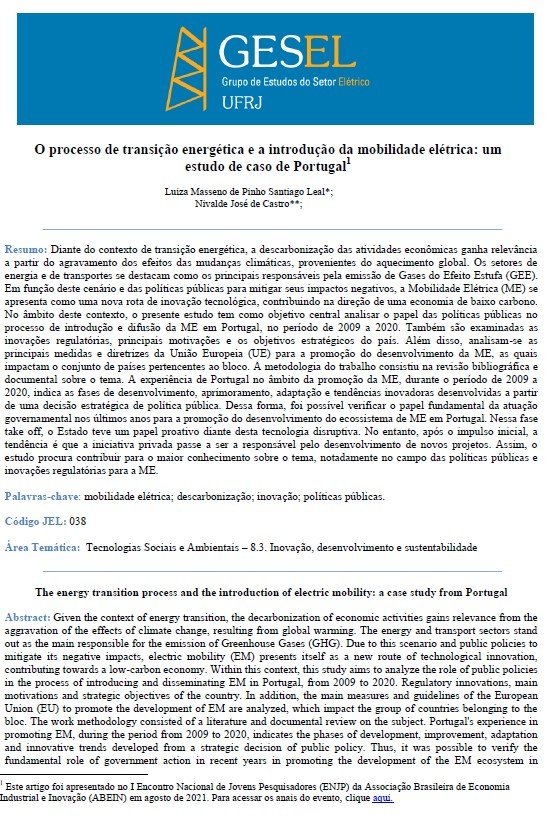
O processo de transição energética e a introdução da mobilidade elétrica: um estudo de caso de Portugal
Author: Luiza Masseno de Pinho Santiago Leal - Nivalde José de Castro
Year : 2021
Diante do contexto de transição energética, a descarbonização das atividades econômicas ganha relevância a partir do agravamento dos efeitos das mudanças climáticas, provenientes do aquecimento global. Os setores de energia e de transportes se destacam como os principais responsáveis pela emissão de Gases do Efeito Estufa (GEE).
Leer más

RIIO-2 Framework Decision
Author: Luiza Masseno de Pinho Santiago Leal - Nivalde José de Castro
Year : 2018
We set price controls for the companies that operate the gas and electricity networks in Great Britain using the RIIO framework. We do this by setting Revenue using Incentives to deliver Innovation and Outputs. We introduced RIIO in 2013. This decision on the framework will apply to the second round of RIIO price controls (RIIO-2) that will begin in 2021 for gas distribution and gas and electricity transmission network. This framework will also apply to the electricity system operator. The next price control for electricity distribution network operators (DNOs) will begin in 2023. Our objective for RIIO-2 is to ensure that regulated network companies deliver the value for money services that both existing and future consumers want.
Leer más
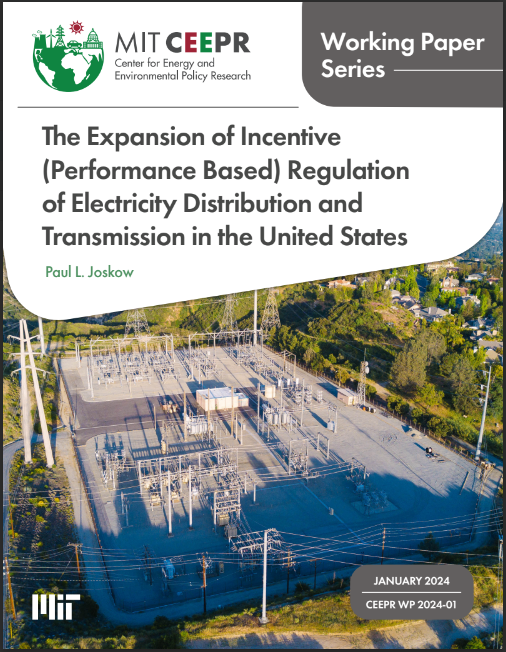
The Expansion of Incentive (Performance Based) Regulation of Electricity Distribution and Transmission in the United States
Author: Paul L. Joskow
Year : 2024
Applications of comprehensive PBR to electricity distribution had been slow to diffuse in the United States prior to roughly 2000. PBR mechanisms are now being applied more frequently to electricity distribution, reflecting the changing structure of the electric power industry and the increasing obligations being placed on electric distribution companies. The new obligations are a consequence primarily of aggressive targets for decarbonizing the electricity sector in nearly half the states and the goal of using “clean” electricity to electrify transportation, buildings, and other sectors. PBR should be viewed as a set of “building blocks” that can be adopted in various combinations and should recognize that PBR and traditional cost of service regulation (COSR) are properly viewed as complements rather than substitutes.
Leer más

Análisis de regresión de SAIDI y SAIFI: Latinoamérica y Oceanía
Author: BA Energy Solutions
Year : 2024
Con el objetivo de evaluar la relación entre la calidad de servicio con el VAD, densidad de clientes y pérdidas de energía eléctrica, se procesó información pública correspondiente a empresas Latinoamericanas y de Oceanía, como parte de nuestro programa de benchmarking anual.
Leer más