ADELAT and ISCI come together to analyze the challenges of electrical distribution

ADELAT and ISCI come together to analyze the challenges of electrical distribution
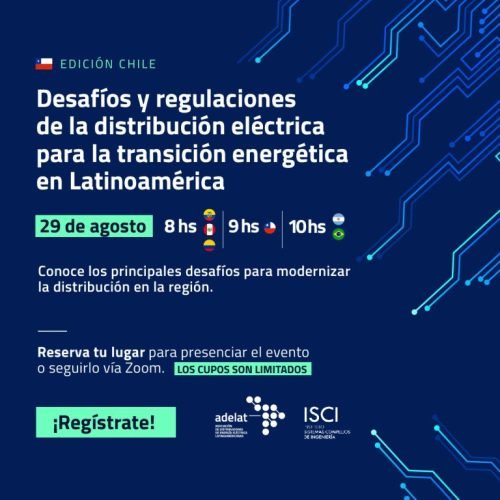
The Association of Latin American Electricity Distributors and the Institute for Complex Engineering Systems will carry out the Chilean edition of the discussion “Challenges and regulations of Electricity Distribution for the Latin American Energy Transition”.

The event will be held on August 29 at 9 am (GMT-4) at the University of Chile and will be broadcast to all interested parties via Zoom. Government authorities, sector specialists and representatives of leading energy companies will participate and it will be open to the public.

The event will be opened by the president of ADELAT, David Felipe Acosta Correa; the executive director, Ignacio Santelices, who will present the policy document made by the Association; and Matías Negrete, academic at the Pontificia Universidad Católica de Chile and ISCI researcher. It will feature a special presentation by Mauricio Riveros, head of the Sustainable Energies division at the Chilean Ministry of Energy.


They will participate in the debate Marco Mancilla, CNE Executive Secretary; Rodrigo Moreno, academic at the University of Chile and ISCI researcher; Mauricio Riveros; and Paola Carrasco, Enel Network Development Manager. The moderation will be in charge of Larissa Cunha, Director of Knowledge Management of ADELAT

The meeting will examine regulatory frameworks and aspects of great importance for the present and future of the region within the scenario of the energy transition and the Chilean context will be analyzed in depth. The main objective is to promote growth and progress in these key points to achieve an approach to maximize the social benefits of investments and achieve modern, resilient and flexible electricity distribution systems.

The need to consolidate the new role of electricity distributors as Distribution System Operators to adapt and make the energy transition in Latin America more efficient will also be explored.

Complete the form to join us  https://forms.gle/Z9n81xBR62s5ANdi6 Quotas are limited. You can choose face-to-face or online.

We will wait for you!

ADELAT and WEC articulate efforts towards a fair energy transition for the region

ADELAT and WEC articulate efforts towards a fair energy transition for the region

The Association of Latin American Electricity Distributors and the World Energy Council in Latin America (WEC, for its acronym in English) formalized a work plan to promote activities and initiatives that contribute to joining efforts towards a clean and fair energy transition for the region.

The work agenda will be aligned with the World Energy Trilemma proposed by WEC to reaffirm the commitment and promote initiatives that collaborate in humanizing energy. In this way, ADELAT joins the cooperation to guarantee equitable access to energy sources, the sustainability of all energy distribution projects and security in energy distribution mechanisms in the region.

“The planning of activities in conjunction with the World Energy Council in Latin America allows us to continue aligned with the World Energy Trilemma and its objectives: energy security, sustainability and equal access. We believe it is a way to push and join forces to achieve a fair and clean energy transition for the region”, Santelices said. 

The aim is to develop strategies to promote improvement opportunities and measure the impact that the energy transition will have on the energy sources of the future.

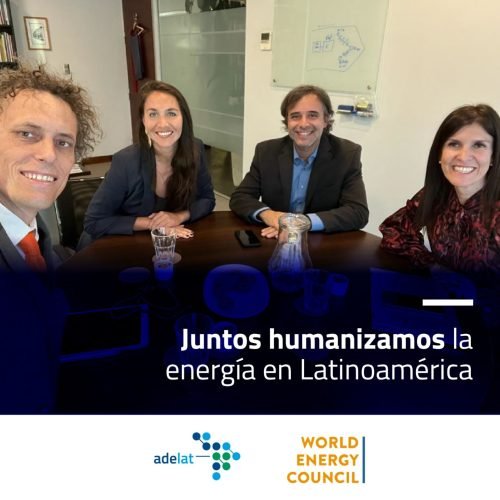
The executive director of ADELAT, Ignacio Santelieces, and the director of Strategy and Institutional Relations, Aniella Descalzi, met with the Regional Vice Chair of WEC Latam, Claudio Seebach, and the Senior Regional Manager, Haydee Jiménez, to start this mutual cooperation.

“The World Energy Council is the world’s oldest independent and impartial community of energy leaders and professionals. Founded in 1923, it has brought together diverse interests from across the energy ecosystem for a century. Through our vision of Humanizing Energy, we involve more people and communities in accelerating clean and fair energy transitions in all regions of the world,” said Seebach.

From ADELAT, it is a great satisfaction to continue strengthening ties of understanding that allow articulating knowledge, actions and exchanging experiences and contributions from all the actors. This is the way to continue with one of the main objectives: to achieve the benefit of all people through a modernization of electricity distributors within the framework of the energy transition.

With the focus on electromobility, what regulation logics do distributors “demand”?

With the focus on electromobility, what regulation logics do distributors “demand”?

Projecting around a million electric vehicles in 15 years in the regional capitals, Latin American distributors request updates to the regulation of each country to adapt to electromobility.

As we always mention, the ecosystem and regulation of electromobility has many actors. This time, several gathered at the Mobility Portal event entitled “Electric and Sustainable Mobility in Latin America and the Caribbean – Success Stories 2023”.

Within this framework, Ignacio Santelices, executive director of the Association of Latin American Electricity Distributors (ADELAT), offers his position on electric vehicles in the sector he represents.

“The world of distribution is demanding to update regulations that have been going on for decades and respond to a different logic,” says Santelices.

And he adds: “In this scenario of electrification of consumption and in which we are going to multiply the amount of electricity, we have to work with different logics.”

The professional participated in the panel “Projects for the expansion of the electric vehicle recharging infrastructure” in which several of the participants agreed on the need for standards that talk among themselves to promote the market.

Specifically, the director of ADELAT requests: “Bring the regulations into the 21st century and prepare us for what is to come, which is going to be tremendous because we are not prepared in the region to fully address the energy transition we are experiencing.”

When asked which actors should regulate the charging infrastructure space, Santelices’s response was: “There are two actors: the superintendence or the energy regulator and the transport regulator that have to work in coordination.”

In this sense, the argument indicated that the transport authorities would be in charge of the standard in, for example, conversion of vehicles and safety of electric vehicles. And, on the other hand, the energy authorities must regulate the charge.

“We need to have a well-integrated and comprehensive vision of these challenges, we have to see how we make a great reform and address the issue of transmission, distribution of electric vehicles, charging, etc.,” says the representative of ADELAT.

From what was stated in the participation of the event, the conclusion is that this comprehensive vision is important for regulators from different countries to have.

Regarding what electromobility represents for the distribution sector, Santelices explains: “It is a tremendous challenge for the distributors of the future and it is a relatively immediate future.”

ADELAT does not rule out thinking that in less than 15 years in the capital cities of the region between 700,000 and one million electric vehicles will circulate.

Faced with this scenario, Santelices admits: “We have to prepare the electrical networks for that moment and for that we have to make new investments, have new regulations, flexibility and digitization in order to have the charging systems coordinated.”

Fountain: https://portalmovilidad.com/logicas-de-regulacion-mercado-de-distribucion/

Yanotti: “If we add electric cars without storage to consumption, the situation becomes critical”

Yanotti: “If we add electric cars without storage to consumption, the situation becomes critical”

To avoid “cuts” caused by connecting electric vehicles to the network, it will be essential to update the distributed generation law. Next, the opinion of the Undersecretary of Electric Power of the Nation.

At the beginning of 2023, the undersecretary of Electric Power of the Nation, Santiago Yanotti confirmed that the agency is working on regulatory material on energy storage and its relationship with electric vehicles.

To find out more details about this initiative, Portal Movilidad talks with the president, who explains:

“The importance is given by the need to guarantee safety and reliability in the electrical system.”

“In periods of peak consumption, cuts occur due to the inability to supply the demand. If we add electric vehicles without storage, the situation becomes more critical. It is not essential to start, but it is to achieve mass electromobility ”, adds the undersecretary.

It should be remembered that this work is carried out within the framework of the efforts being made by the National Secretariat of Energy to modify the current standard of distributed generation.

In this way, the agency will seek to make further progress throughout the country and meet the objectives set forth in both Law No. 27424 and Law No. 27191 and the various climate change mitigation plans.

At the time, Yanotti anticipated Energía Estratégica: “The Ministry of Energy convened the regulatory framework commission of the Federal Energy Council to discuss modifications to the distributed generation regulations that allow for greater development.”

And he adds: “The reality is that, as provided for in the law, it is not possible to comply and many provinces report that the rule prevents progress, according to their own regulations, since it is injected into distribution networks, which are provincial jurisdictions” .

As of today, from the organization they are “analyzing comparative legislation and dialoguing with sectoral actors”.

In addition, with regard to sustainable mobility, they participate in different sectoral tables made up of the public and private sectors.

Latin American distributors “demand” to update regulations. The need to make modifications to the rules that regulate the use of energy is not a problem that concerns only Argentina.

On the contrary, Ignacio Santelices, executive director of the Association of Latin American Electric Power Distributors (ADELAT), during the Mobility Portal event entitled “Electric and Sustainable Mobility in Latin America and the Caribbean – Success Stories 2023”, indicates:

“The world of distribution is demanding to update regulations that have been going on for decades and respond to a different logic.”

“In this scenario of electrification of consumption and in which we are going to multiply the amount of electricity, we have to work with different logics,” adds Santelices.

It is worth mentioning that making these modifications becomes essential considering that, according to ADELAT, in less than 15 years in the capital cities of the region between 700,000 and one million electric vehicles will circulate.

Faced with this scenario, Santelices acknowledges: “We have to prepare the electrical networks for that moment and for this we must make new investments, have new regulations, flexibility and digitization in order to have the charging systems coordinated.”

Fountain: https://portalmovilidad.com/yanotti-vehiculos-electricos-sin-almacenamiento/

How is the regulation for the access and connection of renewable energy plants?

How is the regulation for the access and connection of renewable energy plants?

We spoke with David Felipe Acosta, president of Adelat (Association of Latin American Electricity Distributors) who explained the regulation for the access and connection of renewable energy plants in the network.

“We are focused on producing adequate knowledge to be able to establish efficient investments and seek that these investments that require distribution to ensure that this energy transformation is a reality, are duly remunerated”, he assured. In addition, he points out that they are working on improving the quality and resilience of the network.

Finally, we asked him what are the main problems facing the world of power plants. “Latin American countries are evolving based on the needs that appear. We are accompanying and advising so that the connection is as timely and fast as possible but, above all, that we can ensure a reliable operation”, points out David Felipe Acosta.

Fountain:https://www.negocios.com/como-es-la-regulacion-para-el-acceso-y-conexion-de-plantas-de-energia-renovable/